Discovery of Ice XXI: A New Ice Phase and Multiple Crystallization Pathways Under Extreme Pressure
 Admin
Admin
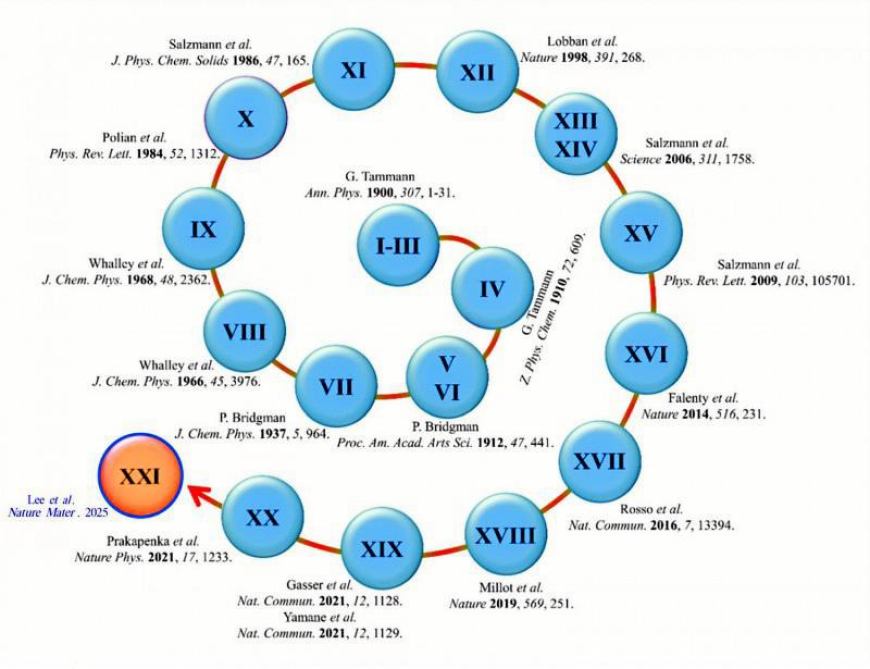
The Korea Research Institute of Standards and Science (KRISS), led by President Lee Ho Seong, has achieved a groundbreaking scientific milestone: the successful observation of water’s multiple freezing-melting processes under ultrahigh pressure exceeding 2 gigapascals (GPa) at room temperature, on a microsecond (μs) timescale. This remarkable achievement marks the world’s first discovery of an entirely new crystallization pathway of water, resulting in the identification of a new ice phase—Ice XXI.
While ice commonly forms when water cools below 0 °C, under certain conditions, water can freeze at room temperature or even above its boiling point. This process is heavily influenced not just by temperature, but also by pressure. At room temperature, when water is subjected to pressures greater than 0.96 GPa, it transitions into Ice VI, one of the many phases of ice that scientists have discovered under extreme conditions.
The complex and diverse structures of ice are shaped by the intricate hydrogen-bonded network between water molecules. This network can undergo significant distortion and rearrangement depending on both temperature and pressure, leading to a variety of ice phases. These structural transformations have been the subject of much study over the past century, with scientists identifying 20 distinct crystalline ice phases. The region between ambient pressure (0 GPa) and 2 GPa, in particular, has been a key area of research, as it encompasses over ten dense and poorly understood ice phases.
In a groundbreaking development, the KRISS Space Metrology Group successfully generated a supercompressed liquid state—where water remains liquid even at pressures exceeding 2 GPa at room temperature—more than twice the pressure at which crystallization was previously observed. This feat was achieved using KRISS's innovative dynamic diamond anvil cell (dDAC). Unlike traditional diamond anvil cells (DACs), which rely on mechanical bolts to apply pressure and often create pressure gradients, the dDAC technology minimizes mechanical shock and significantly shortens compression time from tens of seconds to just 10 milliseconds. This capability allowed water to be compressed into the pressure range where Ice VI is typically stable, but with unprecedented precision.
To capture the crystallization process of this supercompressed water, the research team combined the dDAC technology with the European XFEL, the world’s largest X-ray free-electron laser facility. This collaboration enabled them to observe the crystallization process with microsecond time resolution, revealing a series of unknown and complex crystallization pathways at room temperature. The team discovered that these pathways culminated in the formation of Ice XXI, the 21st distinct crystalline ice phase to be identified.
Ice XXI, which forms at room temperature under ultrahigh pressure, has a crystal structure with a remarkably large and complex unit cell—the smallest repeating unit in a crystal lattice—compared to any previously known ice phases. Its structure is characterized by a flattened rectangular shape, with the two base edges being equal in length, offering a unique geometry not seen in earlier ice phases.
The research was conducted through a large-scale international collaboration that involved 33 scientists from South Korea, Germany, Japan, the United States, and the United Kingdom, in addition to researchers from the European XFEL and DESY.
The discovery of Ice XXI represents a monumental step forward in our understanding of water’s behavior under extreme conditions, with profound implications for the study of planetary science, high-pressure physics, and materials science. By gaining insight into the crystallization mechanisms of water at such high pressures, researchers are now in a position to explore new and exotic materials that have never before been observed on Earth.
Courtsy: Nature Materials, Oct 2025